The parents of the Prophet Mohamed: Abd Allah and Amina
ByMuhammad
“The light that was with you yesterday has left you. » The day before, near the Kaaba, a woman offered herself to ʿAbd Allâh, the future father of the Prophet Mohamed. In the meantime, he married Âmina, and Âmina is expecting a child. What this woman saw in her face, it is said, has disappeared.
The son saved from sacrifice
ʿAbd al-Muttalib1 is the ruler of Mecca and the grandfather of the Prophet Mohamed. Years ago, he made a wish. If God gives him ten sons, and they grow up enough to defend him, he will sacrifice one of them to God, near the Kaaba.
The ten sons are there. The fate designates ʿAbd Allâh. To save him, lots are drawn between him and camels, until the lot falls on the camels. A hundred camels are slaughtered in his place2.
ʿAbd Allâh is spared. ʿAbd al-Muttalib leaves holding his hand.
The woman near the Kaaba
On the way, it is claimed, they pass a woman. She is from the Banû Asad clan3from the tribe of Quraysh4. She is the sister of Waraqa ibn Nawfal5. She stands near the Kaaba6.
She looks at the face of ʿAbd Allâh. “ Where are you going, ʿAbd Allâh? » she asks him.
“ With my father », he replies.
“ I will give you as many camels as were slaughtered for you. Unite with me now. »
“ I am with my fatherhe replies. I can neither disobey him nor leave him. »
Marriage with Âmina
ʿAbd al-Muttalib takes his son to Wahb ibn ʿAbd Manâf. Wahb was at this time the leader of the Banû Zuhra7by birth as well as by rank.
Wahb gives ʿAbd Allâh his daughter in marriage: Âmina bint Wahb8. She is then, says the text, the best woman of Quraysh by birth and by rank9.
His mother and grandmothers also belong to great Quraysh families: Ibn Hisham gives the lineage.
“I don’t need you anymore”
It is claimed that ʿAbd Allâh united with Âmina as soon as the marriage was concluded, on the spot. Âmina then conceives the Prophet Mohamed.
Then ʿAbd Allâh leaves her house. He returns to see the woman who had offered herself to him.
“ Why don’t you offer me today what you offered me yesterday? » he asks her.
“ The light that was with you yesterday has left youshe replies. Today I don’t need you anymore10. »
This woman, the story explains, had heard her brother Waraqa ibn Nawfal speak of a coming prophet. Waraqa became a Christian and studied the scriptures11. He said there would be a prophet among this people12.
Another version: the mud mark
Ibn Ishaq13the author of this story, reports another version. His father passed it on to him.
According to this version, ʿAbd Allâh has another wife besides Âmina14. One day he worked the land, clay that belonged to him. He still bears the marks. He goes to find this other wife and asks her to unite with him.
She is slow to respond. She saw traces of mud on him.
ʿAbd Allah leaves. He performs his ablutions and washes the clay that covered him. Then he leaves to go to Âmina’s house.
On the way, he passes this wife. This time, it’s her who calls him. He refuses. He goes to Âmina and unites with her. Âmina conceives Mohamed.
A white spot between the eyes
Later, ʿAbd Allâh passes in front of this wife again. “ Do you want me? » he asks her.
“ Noshe replies. When you walked past me, you had a white spot between your eyes. I called you, and you refused. You went to Âmina’s house, and she took it away. »
This wife, it is claimed, recounted the scene thus: “ He walked past me with a white spot between his eyes like a horse’s.15. I called him, hoping that this mark would pass through me. He refused. He went to Amina, and she conceived the Messenger of God. »
Thus, concludes Ibn Ishaq, the Prophet was by his birth at the very heart of his people16. And he was the noblest, on his father’s side as well as on his mother’s side.
A chestnut Arab horse marked with white on the forehead: what the Arabic calls the ghurra, the white spot on the forehead, to which the story compares the mark seen on the face of ʿAbd Allâh. Photograph of “Baden de”, 2014, CC BY 3.0, via Wikimedia Commons.
What we say to Âmina
It is claimed, from what people say, and God knows best, that Amina bint Wahb, the mother of the Prophet, related this.
When she was pregnant with him, people came to her. He was told: “ You carry the master of this people. When he comes into the world, say: “I place him under the protection of the One, against the evil of all envious people.” Then call him Mohamed17. »
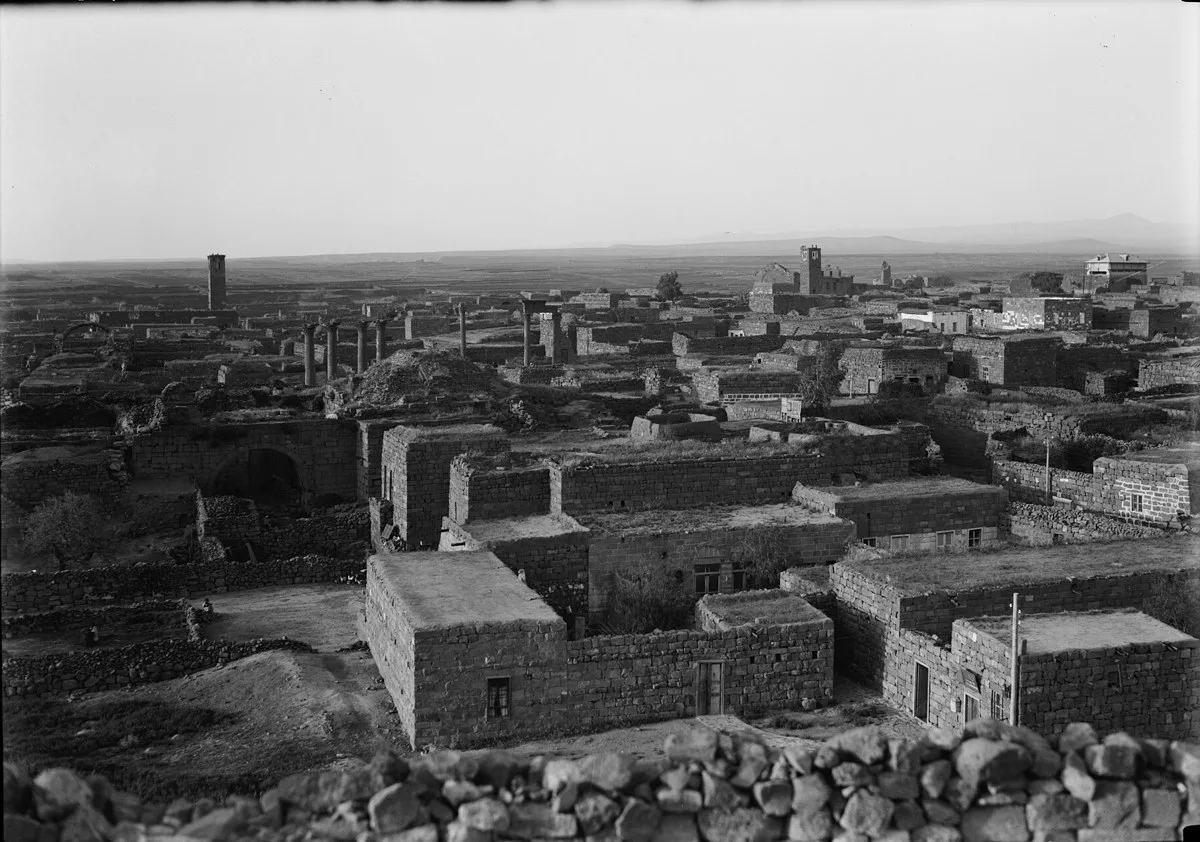
During this pregnancy, Âmina also saw a light coming out of her18. In its light, she saw the palaces of Busra19in the land of Sham, Syria20.
Bosra, ancient Busra, in the south of present-day Syria, seen from its citadel in 1938: basalt houses, columns of the ancient city and, in the distance, towers. Photograph from the Matson Collection (Library of Congress), public domain, via Wikimedia Commons.
The death of ʿAbd Allah
ʿAbd Allâh, the father of the Prophet, did not live long. He dies while Âmina is still pregnant with the child21.
The birth of the Prophet Mohamed is recounted in an upcoming episode of the series.
According to the Sira of Ibn Hisham (chapters “The woman who offered herself to ʿAbd Allâh, son of ʿAbd al-Muttalib” and “What was said to Âmina when she was pregnant with the Messenger of God”), itself taken from the biography of Ibn Ishaq. Story adapted into modern French: the chains of transmission and the genealogies have been removed; no facts were added to the story. The editorial notes provide context.
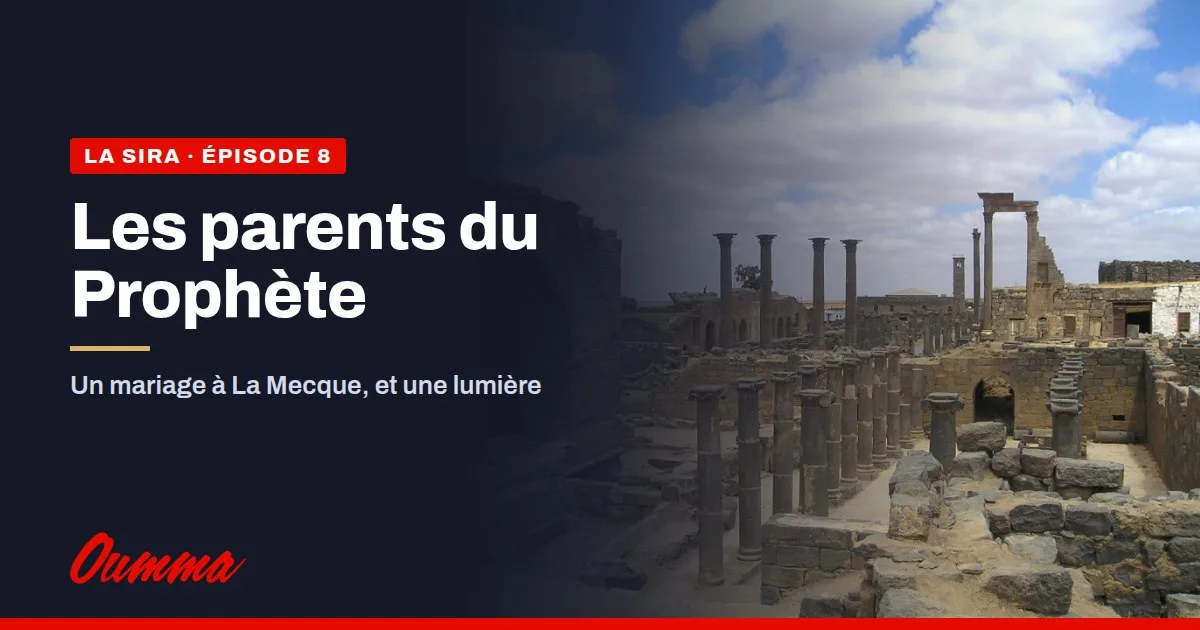
Cover image: the Roman ruins of Bosra, ancient Busra, in 2005, photograph by Heretiq (public domain, via Wikimedia Commons), adapted by Oumma.
Muhammad
Muhammad is a visionary thinker and passionate writer who has been contributing to Understanding Islam for several years.